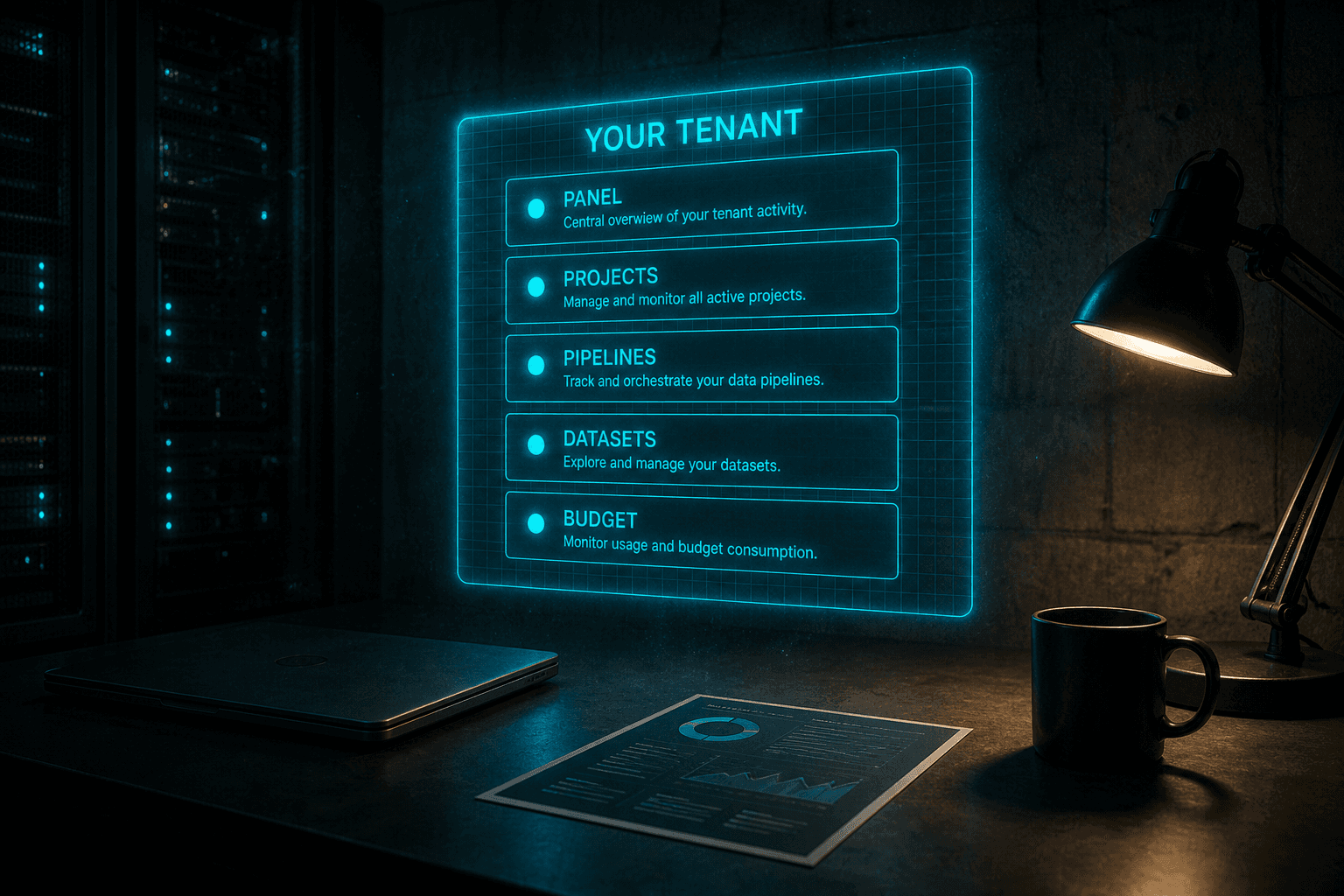
 AI generated
The Crowd Platform is the module of Crowdee where you build and run your own crowd program — your own panel, your own projects, your own task templates, your own input datasets, and your own budget. It is the same platform Crowdee's own agency team runs on for the verification work we sell as a deliverable, exposed as a self-serve product so you can run the same kind of operation in your own tenant.
This is different from the verification products Crowdee is best known for. Verification, content gathering, source research, and continuous monitoring are all delivered outcomes — you bring a piece of content, we send back a verdict. The Crowd Platform is the infrastructure underneath that operation: the panel, the project model, the job engine, the input-data pipeline, the dataset versioning, and the worker payments. If you need to run a recurring program with your own crowd, your own qualification logic, and your own dataset definitions over months rather than weeks, the Crowd Platform is the surface that was built for that.
Every other Crowdee product — the verification pipelines, the finetuned models on the AI Platform, the gathered content from the Content Gathering service — runs on top of the same primitives the Crowd Platform exposes. Buying a verification deliverable and using the Crowd Platform are not separate products; they are the same machinery driving both outcomes.
The Crowd Platform gives you a full panel administration layer for the workers who will do your work. You can recruit applicants, screen them with qualification tests, run quiz-style assessments that gate task eligibility, and configure the rewards workers earn for accepted answers. The same primitives power both registered workers with accounts and anonymous participants who contribute through guest sessions — the latter is useful for short-lived campaigns or for collecting data from sources who don't want to sign up.
The platform models panel rules explicitly: who is eligible for which job, who can see which tasks, what the per-task reward is, and how many different workers are required to answer each item before it's considered covered. Worker profiles carry a billing identity, a payment method, and a history of accepted answers — all under your tenant, all exportable, all subject to your own retention rules. PII is redacted from logs and can be redacted from exports on demand.
If you already have a panel — internal moderators, contracted linguists, a closed group of domain experts — you can bring them in. The platform treats your panel as a first-class object, not a side effect of the job model. This is the part that distinguishes a real crowd product from a survey tool: the panel is the asset, and the jobs are how you exercise it.
Work on the Crowd Platform is organised into projects. A project bundles one ongoing campaign — a research line, a recurring dataset you need to extend, a moderation programme, a content operation that runs every week — and everything you need to run it: the task templates, the input data, the pipeline runs, the dataset versions, and the reports.
You author your own task templates using SurveyJS, attach any input data you want each worker to see for each item, and the platform handles the rest. A single project can attach several pipelines — for example, a content-gathering pipeline that collects candidate items, a crowd job that labels them, and a verification pipeline that audits the labels. Pipelines run in order; intermediate results are persisted as dataset versions so you can go back to any earlier state and rebuild from there.
The input-data layer is what makes this practical at scale. Items in your input data can be plain text, structured rows, files, or pointers to files uploaded separately. When a worker picks up a task, the platform resolves the item they're assigned to the form they see, including any files or media referenced. You can version your input data the same way you version your dataset outputs, so a job that ran last quarter against version 3 of the input set can be re-run today against version 4 with no manual mapping.
Every accepted answer becomes a row in a structured dataset. The dataset is yours: you can inspect it, filter it, export it to CSV or JSON, or feed it straight into a downstream pipeline. Each row carries the worker's submission, the input it was responding to, the timestamp, the reviewer's decision, and any attached files. A live dashboard refreshes every few seconds while a job is open so you can see which items are pending, which are accepted, which are rejected, and which workers are currently active.
Reports are exports of the structured dataset — same content, packaged for the audience that needs to read it. Reports can be filtered, aggregated, and shared with stakeholders outside your tenant via signed links or scheduled exports.
Workers earn credits per accepted answer; credits convert into payouts via PayPal or SEPA bank transfer depending on region. The platform keeps a per-worker balance, a per-job earnings record, and a per-organisation credit ledger, so you can answer the question "how much have I spent on this project, and what is the per-item cost of the next run" without leaving the dashboard. Receipts and worker billing info are exportable for accounting and visa-sponsorship workflows.
The Crowd Platform is the right surface when you have a recurring labelling, moderation, or evaluation need that doesn't fit a one-off deliverable. Newsroom teams running daily fact-check pipelines. Trust-and-safety teams moderating user-generated content at scale. Compliance teams collecting labelled evidence for regulator audits. AI/ML teams building training datasets from a stream of human judgments. Public-sector teams running structured public consultations.
If your need is "verify this one image" or "fact-check this one article," the verification products are faster and cheaper. If your need is "I need to run this same kind of work, with my own panel, my own rules, and my own audit trail, every week for the next two years," the Crowd Platform is the surface that was built for you.
To see what's possible inside a tenant, take a look at the Crowd Platform overview. To discuss pricing for a recurring program, book a demo call — we'll walk through a real workflow from your side, on your data.