 AI generated
"Was this edited?" and "was this ever real to begin with?" are different questions, and our verdict model didn't originally distinguish between them. An image could be manipulated — spliced, retouched, cropped to mislead — while still depicting a real scene captured by a real camera. Or it could be generated end-to-end by a diffusion model, with no original photograph behind it at all. Both are authenticity problems, but they call for different forensic evidence and, frankly, different editorial responses.
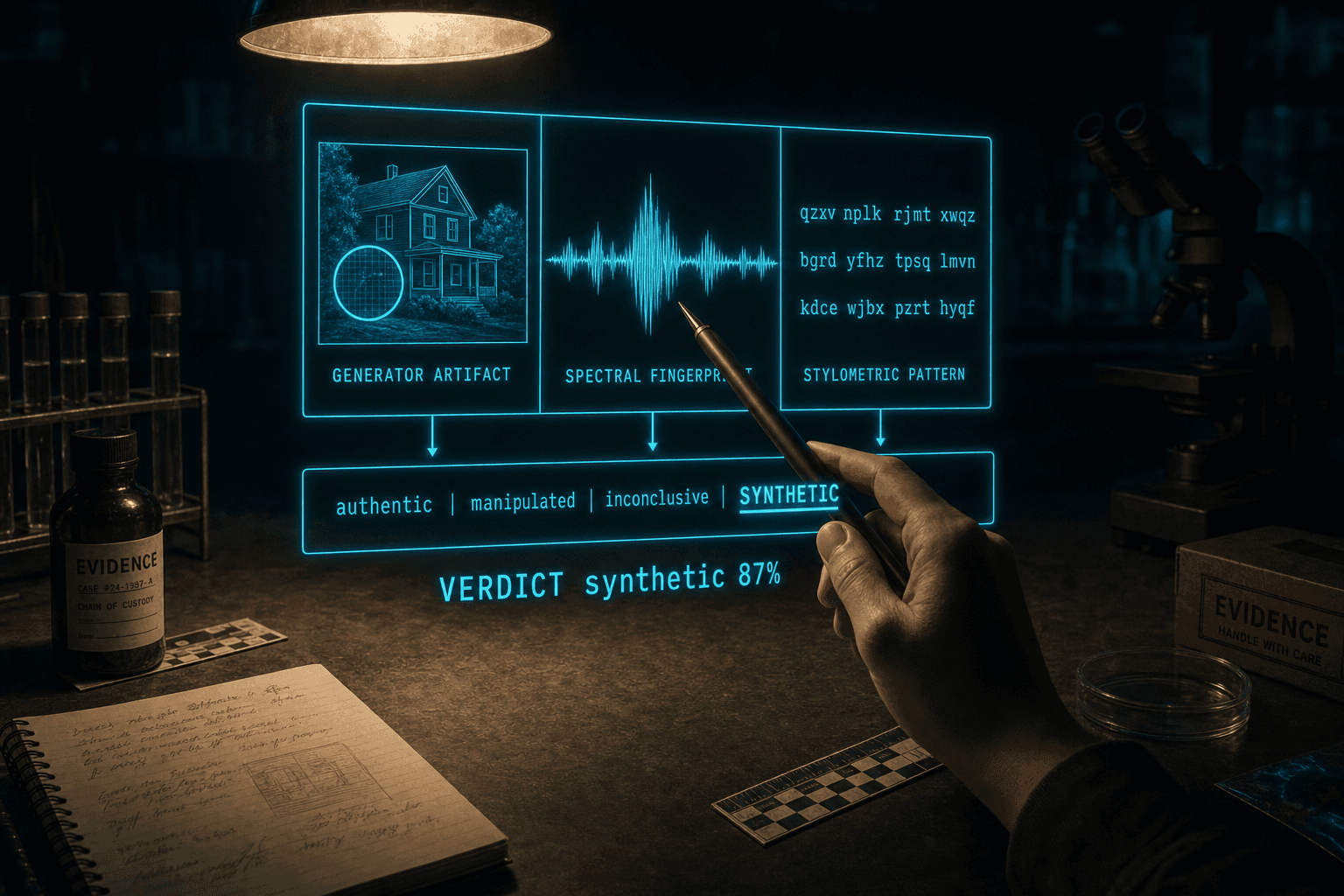
synthetic is now a distinct verdict alongside authentic, manipulated, inconclusive, and unverified. It's not a subtype of "manipulated" — it's a separate finding your workflow can branch on.
Rather than bolt this on as a new standalone pipeline, we added dedicated synthetic-screening stages into the pipelines where it matters most: verify-image-deep and verify-video-full (our Tier 2 AI + crowd deep-review pipelines) now run a synthetic-screening stage after their initial forensic pre-screen and before the visual/frame analysis stage. verify-audio-technical and verify-text-coherence got equivalent additions — audio prosody analysis now scores syntheticLikelihood for TTS and voice-cloning indicators, and text coherence analysis screens for LLM-generated or substantially rewritten prose, citing specific stylometric evidence.
Because these are stages within existing pipelines rather than new pipelines, there's nothing new to configure — the pipelines you already run just return richer output.
Each synthetic-screening stage returns a likelihood score plus a list of specific indicators — generator artifacts for images and video, spectral fingerprints for audio, stylometric patterns for text — rather than a bare probability. That evidence rolls up into the pipeline's final scorecard alongside whatever crowd or expert review stages ran, so a synthetic verdict is exactly as auditable as any other verdict on the platform: you can see exactly what triggered it.
While building this out, we found and fixed something that had nothing to do with new features: our AI stage executor's JSON-format instructions — the schema description we send the model telling it what shape of answer to return — had drifted out of sync with the verdict enum it was validating against. It listed four verdicts and was missing synthetic entirely. Any stage that should have been able to return a synthetic verdict literally couldn't, because the model was never told that option existed. Fixing the instruction text was a one-line change, but it's the kind of gap that's invisible until you go looking for it — validating your prompt scaffolding against your schema, not just your schema against your database, turned out to matter.
Synthetic screening doesn't change what a pipeline costs — it's folded into the existing per-pipeline costCredits, from 500 credits for a fast Tier 1 technical check up to several thousand for a full Tier 2 deep review. See the pipeline catalog for exact figures per pipeline.
Share this article: