 AI generated
An image can pass every forensic check we have — no splicing artifacts, no AI-generation fingerprints, consistent metadata — and still be misleading, because it's being presented as something it isn't. A photo from a 2019 protest re-shared as "breaking news from this morning" is completely authentic and completely misattributed. Our existing pipelines are built to answer "is this real," not "where did this actually come from, and who's behind it." Source Research fills that gap.
Every pipeline stage on the platform up to now was either an AI stage (reasoning over the model's training data) or a crowd stage (routing to human reviewers). Source Research required a third kind: a stage that goes out and searches and crawls the live web while the pipeline is running, so its findings reflect the current state of the internet rather than a model's training cutoff.
We added web-research as a new PipelineStageDefinition type, executed inline like an AI stage — no pause-and-resume needed, since it doesn't wait on humans. Under the hood it runs a metasearch query, crawls the most relevant results, and feeds the aggregated text to an LLM to synthesize findings. It's a genuinely new capability for the platform, not a repackaging of an existing one — this is the first time any Crowdee pipeline reasons over live, current information instead of a model's training knowledge.
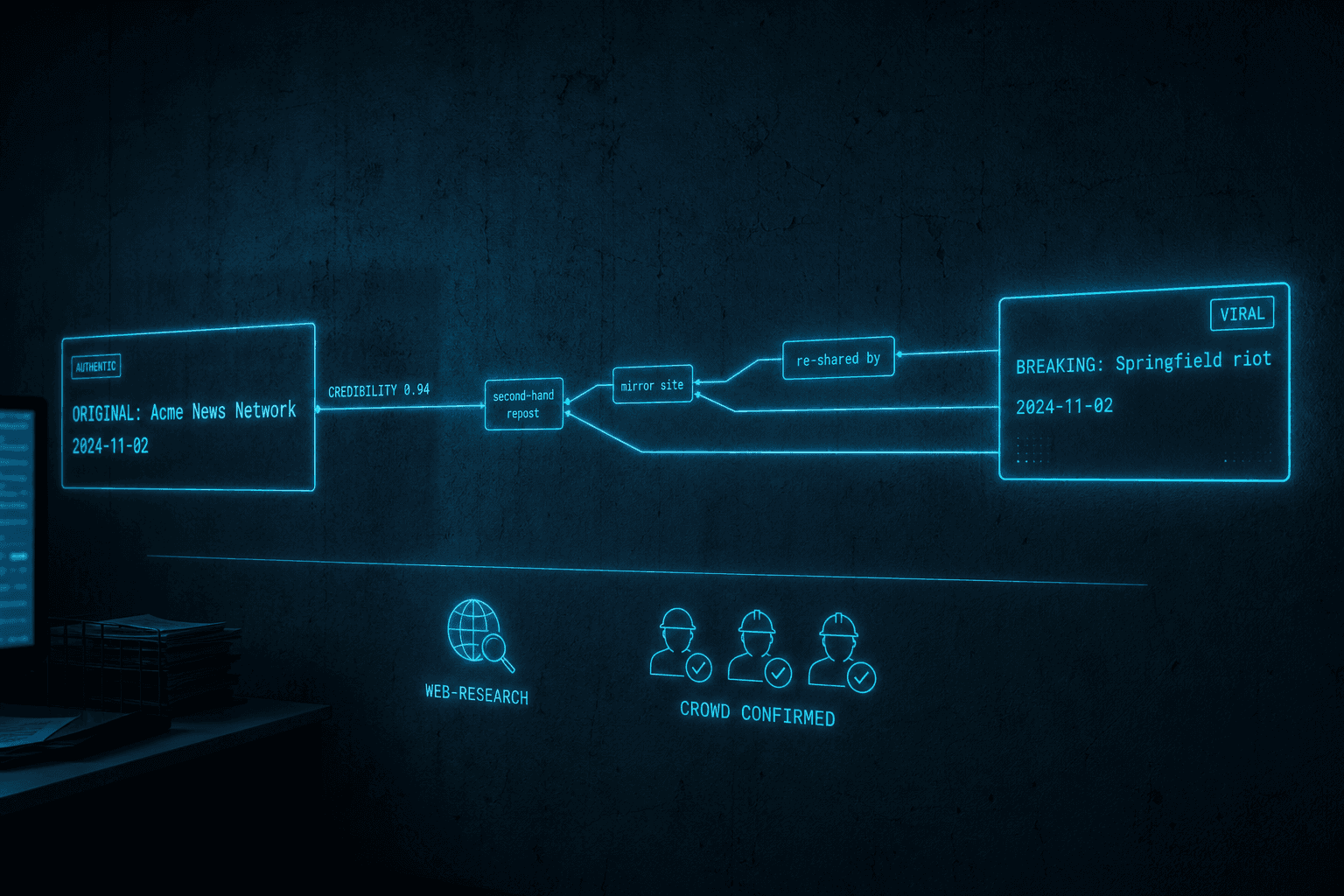
verify-source-credibility chains three stages: web research traces the subject back to its earliest or most authoritative source, an AI stage synthesizes a source pointer and classifies it into a category — government, private individual, or company — and a crowd confirmation stage has fact-checking workers verify or correct that classification before a final scorecard is produced. The result is a source pointer, background on the accounts involved, a category, and a credibility score with a written explanation — not just a verdict on the content itself, but an account of where it's actually from.
Web research can surface a plausible-looking source and still be wrong — search results get gamed, mirror sites republish content with altered context, and LLM synthesis of ambiguous search results can overstate confidence. Rather than ship an AI-only version of this pipeline, we put a crowd confirmation stage between the AI synthesis and the final scorecard: fact-checking workers see the AI's proposed source pointer and category and either confirm it or correct it, with 60% consensus required across at least three responses before the pipeline proceeds. It's the same pattern our Tier 2 verification pipelines use for high-stakes calls, applied here because getting attribution wrong is exactly the kind of mistake that erodes trust in a verification result.
3,200 credits per run, covering the web research stage, AI synthesis, and crowd confirmation together — no separate line items. See the Source Research documentation for the full pipeline reference, and our Web Research concept guide for how the underlying stage type works.
Share this article: